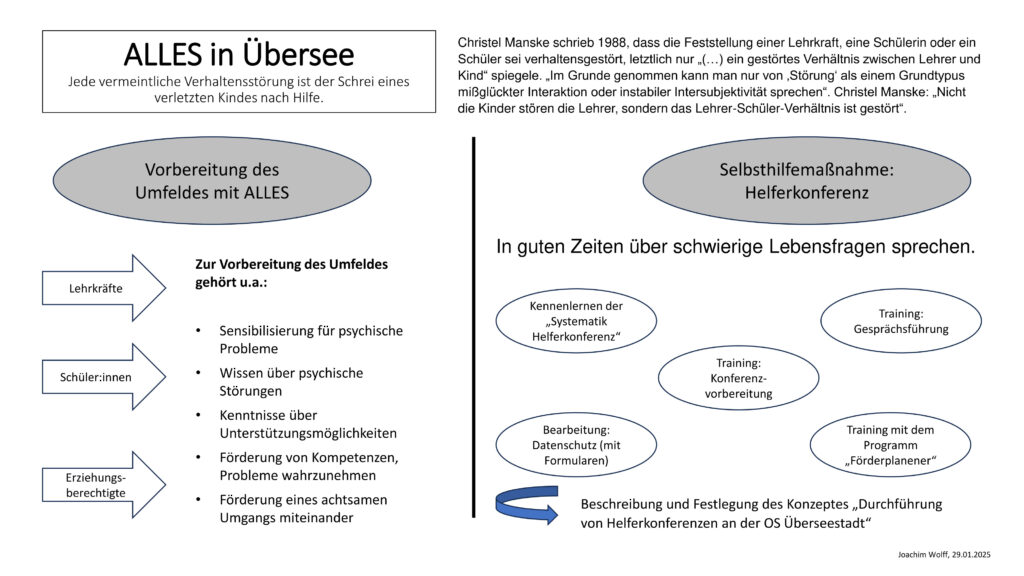
ALLES – a school project to promote equal opportunities, equal access, inclusion, diversity and fairness which aims to reduce educational disadvantage and prevent early school leaving.
To achieve these goals, an international project structure has been created that offers the opportunity for cooperation and best practice at European level, so that schools can learn from each other.
The resulting programme provides knowledge on the following key topics:
Digital media use and mental health
Emotions
Child protection
Children of parents with mental health problems
Mental health / mental illness
Bullying
Shame
Stress & coping
Specific educational programmes that include the above have a lasting influence on the school culture and change it. The project is currently taking place at selected primary and secondary schools in the cities of Berlin, Vienna, Barcelona, Reykjavik and Milan.
The project focuses primarily on training and empowering teachers on the topics of mental health, but also on recognising and communicating factors that promote mental health, as well as recognising risk factors within schools. The ‘whole school approach’ ensures that the programme reaches the entire school.
The entire project is scientifically accompanied by the Carl von Ossietzky University of Oldenburg (Germany).
ALLES is fundedby the EU within the framework of ERASMUS+.
ALLES builds on the positive experiences of its predecessor projects ‘Mindful Schools’ and ‘PASS’, in which children with parents with mental health problems receive support in the context of a school-wide ERASMUS+ approach.
ALLES follows a broader approach that includes further teaching content related to mental health for both primary and secondary schools
and as part of which a training curriculum for teachers and other school staff is being developed.
“[…] Through my involvement in the Erasmus+ project ‘ALLES’, 2025 was a year in which I dealt with issues of mental health and emotional safety more than usual. When you do that, you come across some alarming aspects of the reality of school life: almost one in five pupils has a parent who suffers from mental illness. These children and young people are at least three times more likely to develop mental health problems themselves than pupils who are not affected.
However, mental health is not an issue that affects all social groups equally; it is also a social issue. The consequences of poverty affect children even before they are born: pregnant women living in poverty are at greater risk of malnutrition, anaemia, pre-eclampsia and miscarriage. They experience multiple stressful situations and have fewer resources to cope with these. In addition, their living and residential environments expose them to many adverse difficult environmental conditions. It is therefore not surprising that mental health problems affect schools in disadvantaged areas twice as much as schools in more privileged areas. […]”
Dr. Joachim Wolff, December 2025
(you can access the full letter from Dr. Joachim Wolff here) (in German)
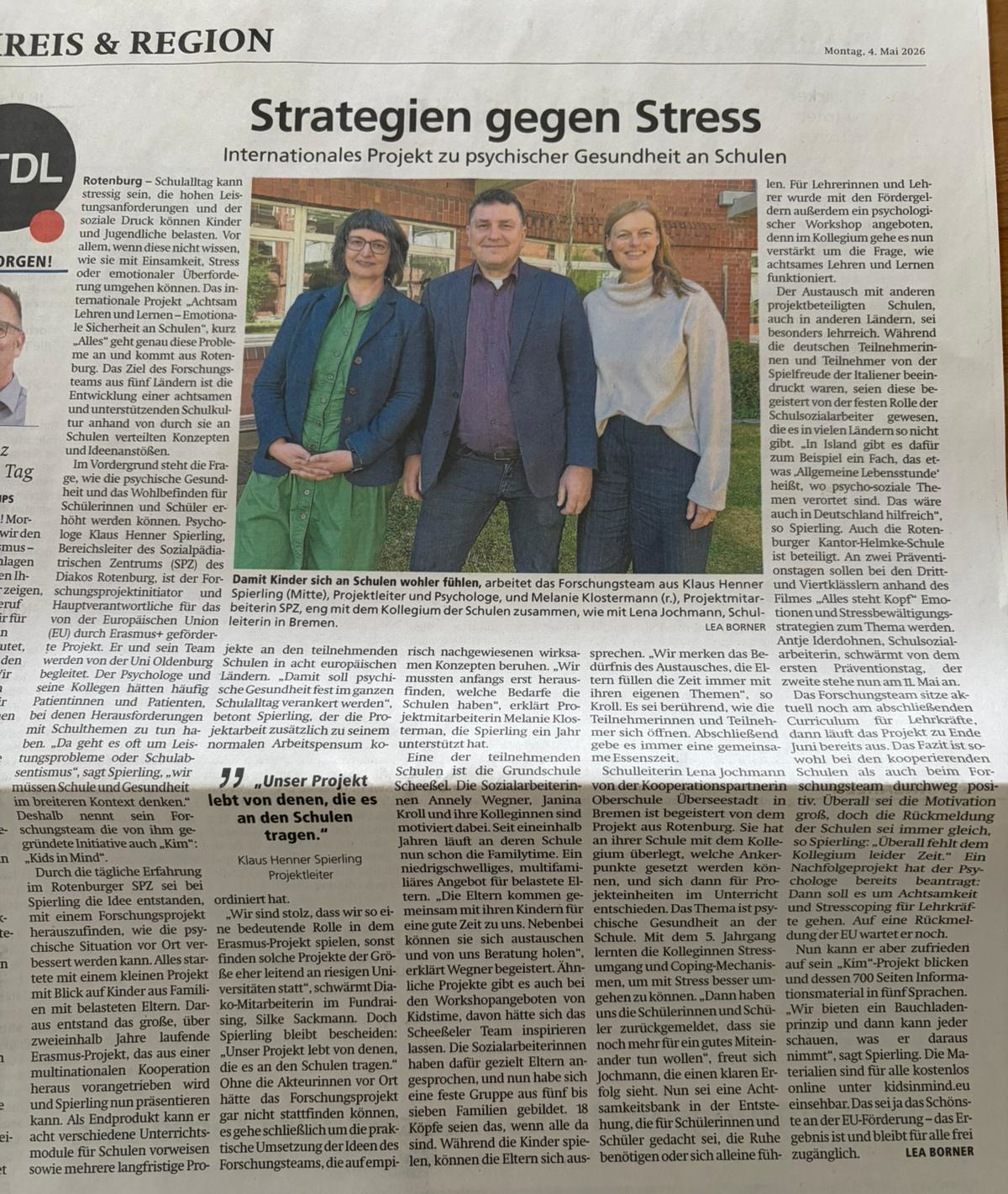
Article in the “Kreiszeitung Rotenburg” (May 2026)